


Selecting the Right Mine Size: A Case Study Using Minemax Scheduler
Mine planning requires precise alignment between mining inventory, processing capacity, and economic assumptions to maximize project value. This article presents a case study on a greenfield gold deposit in Oceania, where strategic scheduling was revisited following new underground exploration results. Using Datamine’s strategic scheduling software solution, Minemax Scheduler, over 200 scenarios were analyzed to determine the optimal combination of open pit size, underground cut-off grade, mining rate, and processing rate for maximum net present value (NPV).
Introduction
Sizing in mining is as critical as in engineering design - oversized or undersized components lead to inefficiencies and lost value. The processing plant must be correctly matched to the mining rate and inventory. This case study demonstrates how scenario-based optimization can identify the most economically viable configuration for a deposit containing both open-pit and underground resources.
Minemax Scheduler was selected for its capability to handle complex scenario analysis efficiently. Although primarily designed for open-pit scheduling, it was adapted to include underground inventory, enabling optimization of the open-pit to underground transition.
How to avoid switching between multiple Minemax Scheduler projects when managing numerous scenarios?
Developing a broad range of scenarios can be time-consuming without an efficient Minemax Scheduler setup. The most effective strategy is to minimize the number of project files, ideally consolidating into one or a few, since switching between multiple projects increases complexity and reduces efficiency.
To run all scenarios within a single project file, the complete mining inventory for every option should be imported upfront. The project can then be structured so that configuring a scenario is as simple as selecting the relevant options.
To navigate scenarios within the same project, simple and consistent naming is key. If the number of scenarios becomes very large - for example, when incorporating variations in mining costs, processing costs, or commodity prices - it may be more practical to use multiple project files.
How to structure a Minemax Scheduler project for rapid scenario configuration?
In this case study, the scenarios were based on pit size, underground cut-off grade and processing rate options. For the open-pit inventory, each pit size was imported as a separate CSV file. Activation of a specific pit design was controlled through the constraints table by toggling movement limits on or off as required.
To prevent overlap between open-pit and underground inventories, Mineable Stope Optimizer (MSO) shapes located inside each pit design and a buffer were removed. Each pit size option was paired with a corresponding underground inventory, which included multiple sets of MSO shapes based on different cut-off grades. These inventories were imported as CSV files linked to their respective pit sizes. Initiating an underground phase required a capital expenditure (CAPEX) decision, where the relevant inventory—defined by pit size and cut-off grade - was activated under the CAPEX definition table.
For processing, a downstream process was created for each plant capacity option and mapped in the decision tree using splits. This configuration enabled processing rates to be turned on or off under the CAPEX definition table as needed.
Case study results
The case study considers seven open pit designs - from extra extra small (XXS) to extra extra large (XXL) - that are derived from optimization shells across multiple revenue factors. It also considers five underground cut-off grades (labelled A to E) and four processing plant capacities - from extra small (XS) to large (L).
Figure 1 illustrates normalized NPV as a function of pit size for the D underground cut-off grade. All open-pit standalone scenarios (shown by the dashed line) resulted in negative NPVs, while the underground standalone scenario (represented by the dot) achieved a higher NPV with an XS plant but remained marginal. The other trends correspond to combined open-pit and underground scenarios, some of which delivered positive NPVs. Among these, the medium (M) plant consistently produced the highest NPV, with the peak occurring at the M pit.
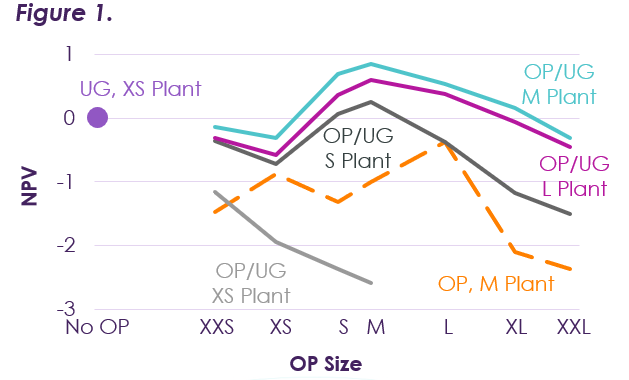
- Figure 1: Normalized NPV versus pit size for the D underground cut-off grade option.
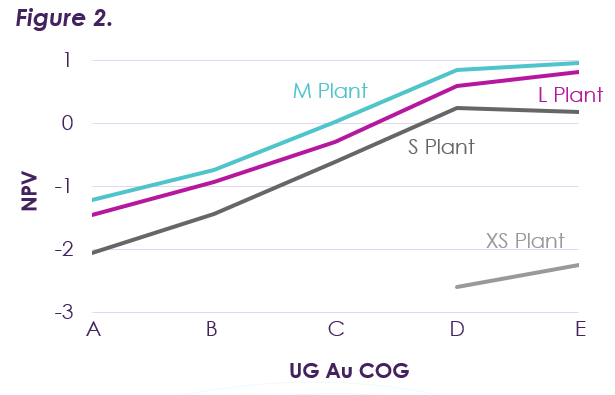
- Figure 2: Normalized NPV versus underground cut-off grade for the M pit option.
Figure 2 illustrates NPV trends with pit size fixed at the M pit while varying the underground cut-off grade. The results show that NPV increases progressively with higher cut-off grades, reaching a peak at option D before stabilizing.
Next Steps
Interested in exploring this case study further? Watch the full presentation by AMC’s Technical Lead, Open Pit Consulting, Olivier Gratessolle, titled Efficient Mine Size Selection, delivered at the Datamine Mine Planning Symposium 2025 in Perth. The recording is available upon registration via this link. For technical insights or to discuss how optimized mine sizing can unlock value in your projects, connect directly with Olivier at ogratessolle@amcconsultants.com.
If you are looking to implement advanced strategic scheduling solutions, reach out to AMC’s Global Lead, Open Pit Mining, Mark Flanagan, at mflanagan@amcconsultants.com.
Let AMC help you transform complex planning challenges into value-driven strategies.
Olivier Gratessolle
Technical Lead Open Pit Consulting
ogratessolle@amcconsultants.com