

Let the Data Speak:
Optimizing Metallurgical Sample Selection for Robust Process Design
Introduction
In metallurgical testing, the notion of a “representative sample” is often taken to mean that a single, well-chosen sample can fully encapsulate the behaviour of an entire ore deposit. This underlying assumption suggests that if the processing plant is designed and tested using this sample, it will operate in a consistent and predictable manner across all feed conditions. However, this idea overlooks a crucial but rarely discussed reality: the true performance of a processing plant is dictated not by the average characteristics captured in a single sample, but by the full spectrum of ore variability encountered over time.
Understanding Sample Representativity
A representative sample should capture the full spectrum of an orebody’s geological, mineralogical, and chemical characteristics that influence processing performance. The misconception that geospatial location drives metallurgical behaviour often leads to suboptimal sampling strategies. Instead, the focus should be on geological variability—what matters more than where.
Variability vs. Composite Samples
- Variability Samples: These are selected to characterize the full range of ore types within a deposit. They should be drawn from continuous intercepts in single drill holes to capture the diversity of geological characteristics. Variability samples are critical for understanding how different ore types respond to processing.
- Composite Samples: These are useful for establishing a feasible process flowsheet but fail to capture the behaviour of individual ore types. They provide an averaged view, masking critical variations that impact plant performance.
The geometallurgical principle for variability sampling is to select samples that span the multivariate characteristics—physical, mineralogical, or chemical—that affect processing outcomes. By prioritizing geological variability, we ensure the process design accounts for the extremes, not just the average.
Determining the Right Number of Samples
A common question is, “How many samples are needed?” The answer depends on the intended use of the data. Let the data guide the decision.
1. Process Design
The goal is to design unit processes that handle ore with average characteristics at a specified throughput. This requires a compromise, balancing typical ore behaviour with operational constraints. A smaller, carefully selected set of variability samples can suffice to establish a robust flowsheet.
2. Geometallurgical Modelling
Geometallurgical models predict ore variability across a deposit, represented as a three-dimensional matrix of blocks derived from the mineral resource block model. These models require a broader set of variability samples to capture localized ore and waste characteristics. The challenge is to determine the point at which additional samples no longer significantly improve the model’s predictive accuracy.
Balancing Sample Size and Model Accuracy
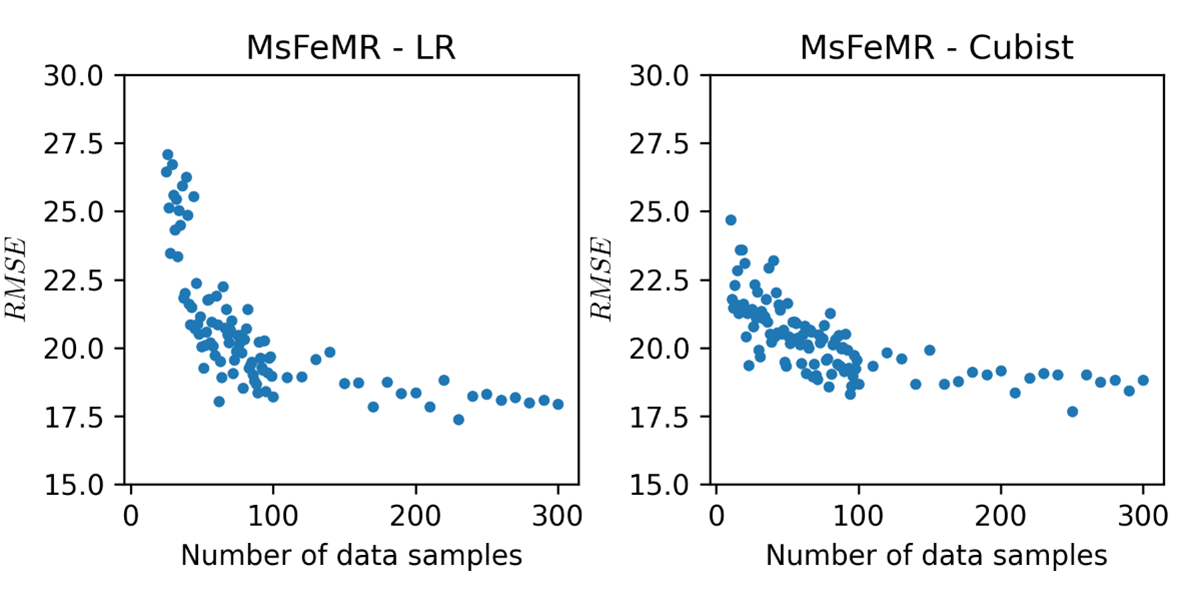
Adding more samples reduces uncertainty in predictive models, but only to a point. Beyond this, inherent test variability limits further improvements. The goal is to identify the minimum number of samples that achieves an acceptable level of uncertainty, optimizing both cost and accuracy.
Leveraging Machine Learning for Sample Selection
Machine learning offers powerful tools to enhance metallurgical sample selection and geometallurgical modelling. By analysing high-dimensional data, these techniques can identify representative samples and assess model uncertainty.
Predictive Modelling with Machine Learning
Training a predictive geometallurgical model with increasing sample sizes allows us to calculate uncertainty, such as the Root Mean Squared Error (RMSE). Initially, RMSE decreases rapidly as more samples are added. However, it eventually stabilizes, indicating that additional samples provide diminishing returns. This inflection point helps determine the minimum number of samples needed for a robust model.
Assessing Representativity with Dimension Reduction
Machine learning techniques like Uniform Manifold Approximation and Projection (UMAP) reduce high-dimensional data into a manageable number of dimensions for visualization and analysis. Grouping algorithms, such as K-Means clustering, evaluate sample similarity based on multivariate characteristics. Users can define the number of groups based on their interpretability and relevance to processing outcomes. These groupings provide a reproducible framework for:
- Describing ore types.
- Selecting representative samples.
- Interpreting geological domains in three dimensions.
By applying these tools, we can ensure samples are representative in a multivariate sense, capturing the full range of ore characteristics that impact processing.
Best Practices for Metallurgical Sample Selection
To optimize sample selection:
- Prioritize Geological Variability: Focus on capturing the full range of ore characteristics rather than geospatial coverage.
- Use Variability Samples for Robust Insights: Select samples from continuous drill hole intercepts to reflect geological diversity.
- Leverage Machine Learning:
Employ tools like UMAP and K-Means clustering to assess representativity and optimize sample size.
- Align Sampling with Objectives: Tailor the number of samples to the purpose—process design or geometallurgical modelling.
- Monitor Model Uncertainty: Use metrics like RMSE to determine when additional samples no longer improve predictive accuracy.
Next Steps
Unlock the full potential of your metallurgical testing by adopting a data-driven approach to sample selection. By focusing on geological variability and leveraging machine learning, you can design more robust processes and predictive models that account for the complexities of your orebody.
Contact our team at geometallurgy_support@amcconsultants.com to learn how we can help you implement these strategies and optimize your metallurgical outcomes. Let the data speak—start building smarter, more reliable process designs today.
Paul Greenhill, FAusIMM(CP)
Principal Consultant
pgreenhill@amcconsultants.com